|
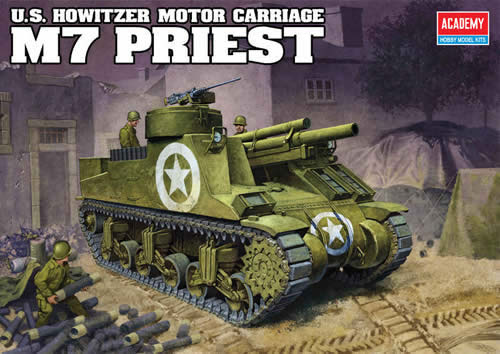
M7
Priest U.S. Howitzer Motor Carriage |
 |
|
Academy
Hobby Model Kits During WWII there were four iconic open-topped self-propelled guns used by the major powers: the German 15 cm "Hummel," the Canadian-designed "Sexton" with a 25-lb gun, the Soviet SU-76M, and the American M7 105mm HMC "Priest." The latter three were excellent designs and went on to live long after the war, all three serving into the early 1960s with various second- and third-world armies. Two of them, the Sexton and the M7, were based on the reliable US M3 medium tank chassis. The M7 came about due to a perceived need for self-propelled armored artillery weapons to keep up with armored divisions. After a number of prototypes were tested, the M7 entered service and full-scale production in April 1942. While it was based on the M3 chassis, it also absorbed many of the changes that came about due to the introduction of the M4 series medium tanks and reflected those changes as production proceeded along. A total of 2,814 were built as well as 826 of the later M7B1, which used the M4A3 tank's Ford GAA engine in place of the original's radial air-cooled engine. Roughly one-quarter of these vehicles served with the Allied forces, going to the British and Canadians (and later replaced by the Sexton, which carried the preferred 25-lb gun in place of the American M2 105mm howitzer) and the Free French forces as well as postwar MAP deliveries to many other countries.
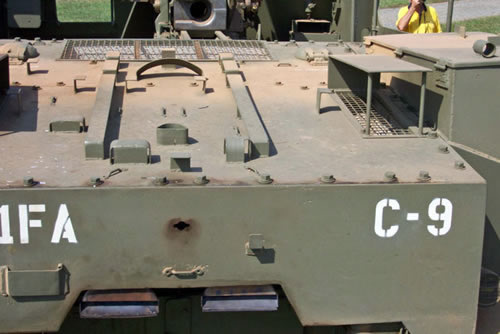
Academy had promised this kit for some time, but after the major problems that cropped up with the M3 Lee kit it apparently went back for some revisions. The kit is now on its way to the shops, and as the critics have already started making comments on this kit without ever seeing it, the best way to review the kit is to say what it is and what it is not. What it is, is a fairly accurate representation of what appears to be a mid-production M7 with a riveted hull, T51 tracks and some of the MWO changes that went with it. It comes with the increased ammunition stowage racks which appeared about the time of the Operation Husky landings in Sicily, based on combat operations in North Africa. It has the production three-section bolted transmission housing with the full-size E4151 right side housing section vice the E1230 used on very early production vehicles and taken straight from the M3 medium tank. It has the top-opening stowage bins on the rear deck vice the side-opening ones from the early production series but not the mesh baskets which appeared on top of them or vents which are seen on late production vehicles. It also has the early model shallow "pulpit" for the .50 caliber machine gun. Analyzing the kit, it comes with the M3 lower hull pan (with some subtle revisions, as it does not totally match the one in the M3 kit) and many of the M3's parts for the suspension, but this is primarily to give the modeler his choice of road wheels and idlers. A new set of bogies and drivers is provided separately. Note that very early production M7s and all of the M7B1s appear to have used the welded "spoke" style of road wheels whereas the bulk of production vehicles used the welded "pressed" type with the domed six-ribbed covers. They also used the "fancy" type of machined drive wheel rings (on the new sprue) but with most vehicles using the welded "spoke" type idlers. (This combination seems popular, for you see it on the M10 3" GMC as well.) Using a simple Staedler steel rule, my best estimated is that the new bogie assemblies are 11mm even from the bottom of the hinge mount to the flat top of the bogie casting; those on the unfortunate M3 kit were a hair over 13mm, so the changes have been made to the design. (Hopefully this will be retroactively provided to the M3 kit as well, as it solves it major bugaboo.) The new bogies also come with a choice of facings, either original or with supplemental cross-brace webbing for stiffness; so far I have not seen this on any of the WWII photos I checked on for the model. Each bogie consists of ten to twelve parts – wheels, rocker frames, spring sets, front, rear, return roller, and side flanges for the top of the rear section. Note that the directions would have you use the welded "spoke" road wheels, but as noted this is not as accurate a choice as the welded "pressed" wheels. As noted the transmission cover is the original production three-section bolted one and comes in a total of six pieces (housing, joint strip, bolted flanges, and final drive covers). The hull rear is new and has separate doors, but for some reason comes with the later "square" air cleaners and not the early model "round" ones. The fasteners are provided but as Steve Zaloga has noted look much better if replaced by etched brass ones. The interior of the hull includes all bits which can be seen from the outside, such as the transmission, driver's position, and other basics which go in front or around the gun mount. Note that there are a number of fine ejection pin marks on the inside of the hull sides and glacis which will need removing. The driver's instrument panel is the later M4 style rectangular one and not the longer thinner M3 type. Academy includes the same odd little oval hatch in the belly of the hull, which is some sort of quirk they have in every one of their kits. This is annoying and I wish they would get rid of it, for it serves little or no purpose that I can see as the kits are not motorized. The gun is nicely done but in a totally different manner than I would have suspected. The main portions of the gun come in three sections: muzzle section, main section, and breech. The muzzle is a hollow "slide molded" tube and the main section is a solid plastic molding. Normally this is asking for the appearance of our old friend "Sammy Sinkmark" but Academy cleverly "slide molded" the heavy end of the tube and it comes out smooth and even. The remaining parts are fairly conventional for an artillery piece, and the entire assembly mounts on a subfloor which is installed when completed. (At this stage the kit has the lower hull with details and now the modeler moves to the upper hull.) Most of the upper hull details are well done. Academy has added the boxes usually noted as being grouser racks but instead uses them to stow eight links of T51 track. I looked over my photos to see if that matches and while I found a number of other items in the racks (!) no track links. [EDITOR'S NOTE: tracks stowed in the grouser racks can be seen in several photos in Steve Zaloga's U.S. Armored Artillery in World War II on pages 16, 20, 32, 58, 41, 71.] The one glitch in the entire model that I found is the engine deck. On the original early and mid production M7s, due to problems in the geometry under the decking the vehicle had to have two large mesh vents placed on the rear sides to prevent a buildup of heat and fumes from the gasoline tanks. To prevent them being blocked by the usual kit tossed on the engine deck, they had a bent steel guard over them with two sturdy braces to keep it from collapsing (see photo.) Academy apparently used a late-production or post-war refitted vehicle, as it has the late engine deck without the vents. These will have to be added for an early or intermediate production variant. (The way around this is to do what the MWO said, namely weld some steel bars across the engine deck and use it for expanded stowage. The stowage can then be arranged to block the view of most of the engine deck – bags work wonders! – and obviate the need to fix the vent problem.) Also the three-section vent at the front of the deck is solid, and most modelers will want to replace it with etched brass.
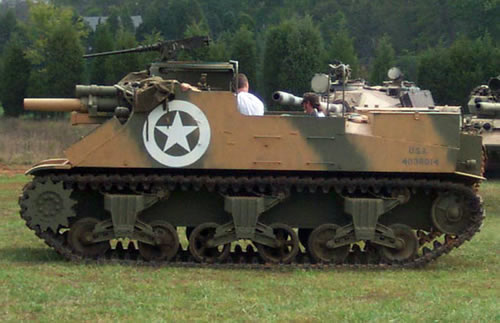
The original M7 came with four crew seats which folded in the rear compartment and at least two versions of stowage before the MWO came out. One had six rounds in a 2 x 3 arrangement at the right rear and six in a 1 x 6 rack down the left side of the hull. The other had two bins, each 3 x 4, at the rear corners of the compartment. The MWO upgraded this by adding 1 x 6 racks in front of the bins and moving the seats, giving the vehicle a total of 36 rounds of ready stowage. This is the option proved in the kit. However, Academy gives you the ammo as two strips of 4 tubes and one strip of 10 tubes per side, and they mount directly in the bin. This means the "eggcrate" slots for individual rounds are not present, so if you want an "in-action" vehicle you will need to add the racks from thin sheet styrene or just strip and black paint. (This isn't wrong at all, but it does limit your options.) The tracks are nicely done but are the non-cementable vinyl type and only attach with one link. My experiences with Academy track is they tend to be a bit loose, but nothing much to worry about. However, I would bet many modelers will switch to better-looking single-link tracks instead. The kit provides a total of three machine guns but only one .50 is used, so you get two of the excellent Academy weapons for the spares box. Markings are again one of the shortcomings of Academy kits, and while they have selected four options none of them seem complete. (It's like Academy seems to forget there is a front and rear to the vehicle; I wish that, like DML, they would have solid researchers on that subject provide them with the necessary info to get it right.) The four options offered are: 2nd Armored Division, Sicily 1943; B Battery (Baboon), 14th Armored Field Artillery Battalion, 2nd Armored Division, Normany 1944; 11th Regiment RHA, 1st Armoured Division, El Alamein 1942; and 31st Firing Battery, 64th RADB, 2nd French Armored Division, France September 1944. The first one is a solid olive drab vehicle, which strikes me as odd as most of the vehicles were painted in a sand over OD finish for Husky. As noted the side markings look complete, but bumper codes seem missing across the board except for one set for "Baboon." Overall, however, this is probably Academy's best effort to date and even with the snafu on the gas vents for the engine provides the basis for a really nice model of the M7. The rest is up to the modeler, but even out of the box it will produce a pretty decent representation of the vehicle. Thanks to Bob Lewen of MRC for the review sample and Steve Zaloga and Joe Demarco for their research and assistance. (Photos are of the VMMV (Cors) Collection vehicle, M7 serial number 1364) Highly Recommended Sprue
Layout - Cookie Sewell See also Saul Garcia's review. |
 |
 |
 |
 |
 |
 |
 |
 |
 |
 |
 |
 |
 |
|
